
Hi
I see some people are adding 2 stroke oil to their tanks when they fill up with diesel...
If I may ask, who does this and why?
What is the advantage of doing it?
What can it prevent?
Thanks
Clauds

Found my answers )
http://www.fuelexpert.co.za/2-stroke-oi ... -study.php
http://www.fuelexpert.co.za/2strokeoilindiesel.php
basically it is not worth it in any way
A few other studies I skimmed through had more or less the same conclusion
http://www.fuelexpert.co.za/2-stroke-oi ... -study.php
http://www.fuelexpert.co.za/2strokeoilindiesel.php
basically it is not worth it in any way
A few other studies I skimmed through had more or less the same conclusion

That fuel expert report was discussed at length on the 4x4community.
It was concluded that
(I have been doing it on both diesel and petrol engines for more than 40 yrs).
It was concluded that
- since oil companies commissioned the test, the result was a foregone conclusion. They surely could not tolerate a report that says it does any good.
- as a technical report, it has glaring errors and omissions
(I have been doing it on both diesel and petrol engines for more than 40 yrs).
Gerhard Fourie
If you want to shoot somebody, make sure you aim at his head, not your own foot.
Me

If you want to shoot somebody, make sure you aim at his head, not your own foot.
Me

Why use it if the manufacturers don't recommend it?
Sent from my iPhone using Tapatalk
Sent from my iPhone using Tapatalk
- Kurt
2014 Pajero SWB 3.2 GLS | EFS Suspension | Stofpad Bashplates
2008 Pajero LWB 3.2 GLS (Sold @ 243,000km)
2014 Pajero SWB 3.2 GLS | EFS Suspension | Stofpad Bashplates
2008 Pajero LWB 3.2 GLS (Sold @ 243,000km)

Kurt,
I'm not going to debate this topic now.
BUT
The fact that VW's own engineers saw a need to override their own specs, means that what the manufacturers say isn't always what is actually the best for the car.
I'm not going to debate this topic now.
BUT
The fact that VW's own engineers saw a need to override their own specs, means that what the manufacturers say isn't always what is actually the best for the car.
Here are some points from the guys that use it:
1) mix it with your fuel at a ratio of 1:200
2) it helps to lubricate the pump and injectors
3) Jaso FC grade removes carbon build-up on the components that are exposed to the combustion gasses.
The paper referred to in this thread didn't find significant lubricity gains. It didn't test lubricity gains in contaminated (water or paraffin) fuel. It didn't test for carbon removal. It did show fouling of injectors by zinc precipitation under extended full throttle application.
I dose my fuel (petrol and diesel engines) only on long distances in the belief that it removes any carbon buildup.
I'm convinced that clean diesel don't require 2SO because it doesn't really help with lubricity (in clean, healthy diesel).
I have no idea if it will help with contaminated fuel, but I'll be surprised if it doesn't. I mean, how else can a 2 stroke petrol engine survive.
PS: Kurt, and there I couldn't stop myself
1) mix it with your fuel at a ratio of 1:200
2) it helps to lubricate the pump and injectors
3) Jaso FC grade removes carbon build-up on the components that are exposed to the combustion gasses.
The paper referred to in this thread didn't find significant lubricity gains. It didn't test lubricity gains in contaminated (water or paraffin) fuel. It didn't test for carbon removal. It did show fouling of injectors by zinc precipitation under extended full throttle application.
I dose my fuel (petrol and diesel engines) only on long distances in the belief that it removes any carbon buildup.
I'm convinced that clean diesel don't require 2SO because it doesn't really help with lubricity (in clean, healthy diesel).
I have no idea if it will help with contaminated fuel, but I'll be surprised if it doesn't. I mean, how else can a 2 stroke petrol engine survive.
PS: Kurt, and there I couldn't stop myself
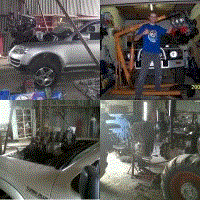
Affiliate Member
adding 2so is slightly worse for the environment as it most contains sulphur. That is why the manufacturers don't recommend it.
EGR systems are bad for engines but good for the environment. So we blank them off.
It has been noted by many how 2so can clean carbon deposits in n engine. It does it very well. It is designed to do that. It is also designed to lubricate.
Now who wouldn't want some extra lube in a R40k common rail pump that pumps 2000 bar. Yes, 2000 bar! And who wouldn't want their combustion chamber and rings and VGT turbos free of carbon?
I use it in the company fleet and my own car consisting of
Mitsu 3.2 diesel gen4
Triton 2.5 TD
Ford Ranger 2.5TD
Land Cruiser 4.0 V6
Touareg 2.5 TDi
CAT D6 bulldozer
Landini Tractor
Kubota D45
Other than my touareg which was a lemon to start with at the beginning but since then no turbo, egr, or injector issues on any of them. That's a much bigger dataset and a more real world result than that sasol test (the sasol test indicated that your injectors would completely fail in about 16'000km based on their fouling percentage - clerly that's not the case)
EGR systems are bad for engines but good for the environment. So we blank them off.
It has been noted by many how 2so can clean carbon deposits in n engine. It does it very well. It is designed to do that. It is also designed to lubricate.
Now who wouldn't want some extra lube in a R40k common rail pump that pumps 2000 bar. Yes, 2000 bar! And who wouldn't want their combustion chamber and rings and VGT turbos free of carbon?
I use it in the company fleet and my own car consisting of
Mitsu 3.2 diesel gen4
Triton 2.5 TD
Ford Ranger 2.5TD
Land Cruiser 4.0 V6
Touareg 2.5 TDi
CAT D6 bulldozer
Landini Tractor
Kubota D45
Other than my touareg which was a lemon to start with at the beginning but since then no turbo, egr, or injector issues on any of them. That's a much bigger dataset and a more real world result than that sasol test (the sasol test indicated that your injectors would completely fail in about 16'000km based on their fouling percentage - clerly that's not the case)
Wow, didn't expect to get so much good information
Thank you all for your input, I will be adding to my tank from here on in
Thank you all for your input, I will be adding to my tank from here on in
